Data centers have powered our digital lives for decades — enabling Google searches, YouTube videos, email, online banking, cell phone service, and nearly every modern convenience. Many began as on-premises server rooms in local businesses — energy-intensive and expensive to install and maintain — before the industry shifted to larger, more efficient centralized facilities.
In East Central Indiana, new proposals have sparked strong local debate: moratorium discussions, concerns about water usage, higher residential power rates, farmland conversion, jobs, potential property value impacts, and environmental questions. These concerns are legitimate and deserve straightforward answers.
As your local IT partner serving financial services, healthcare, nonprofits, and small businesses, we see data centers through a practical lens: they require reliable power, robust networking, strong cybersecurity, and smart infrastructure. Done right, they become an asset to the local economy (and by extension the community at large). The key phrase being "done right". Keep reading for our balanced take on the key issues, along with pragmatic solutions for responsible development that can benefit our communities.
Water Usage: A Legitimate Concern with Modern Solutions
By far the largest concern about data centers is the amount of water they use. Traditional evaporative cooling works by pulling hot air through a wet cooling medium; as the water evaporates, the air temperature is lowered drastically. It's a highly effective system, but in large data centers it can consume hundreds of thousands to millions of gallons per day. This is a valid worry and is probably what most people think of when they're expressing concerns about water usage.
Modern closed-loop and waterless systems change the equation significantly. In closed-loop systems, the same water is recirculated instead of being lost to evaporation. The only water usage is the initial fill of the system and periodic top-offs. Waterless systems use special dielectric fluids (sometimes even immersing the servers directly into the liquid) to draw the heat away from servers and into heat exchangers for dissipation to the outside air.
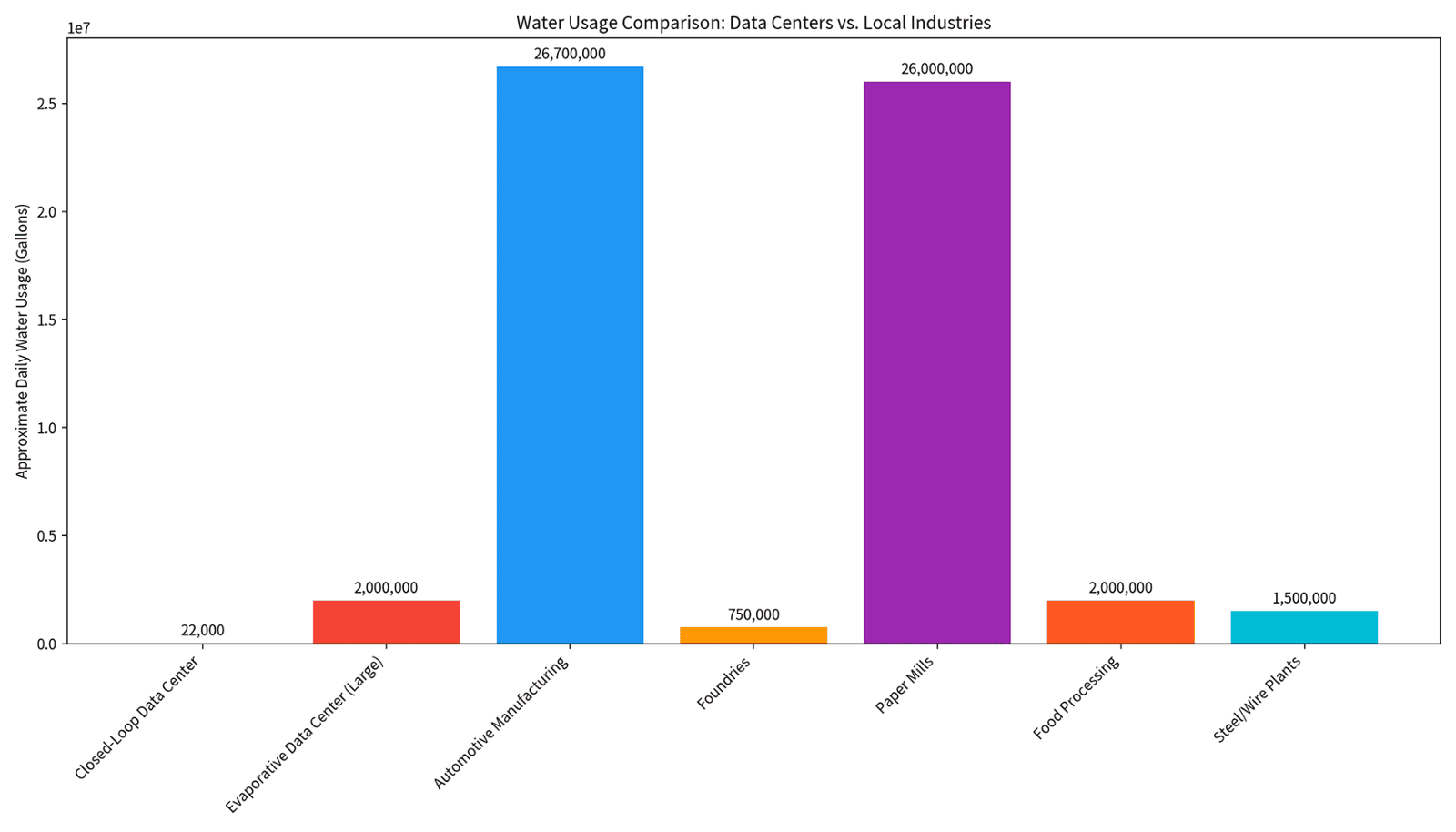
In both systems, the ongoing daily cooling use can drop to near zero with dry coolers or closed liquid loops. In one real-world example using closed-loop + dry heat rejection, the peak water use was around 22,000 gallons per day for mostly non-cooling needs like restrooms and cleaning, compared to 5 million gallons for a similar-sized facility using traditional evaporative designs.
Comparison to Other Indiana Industries (approximate; actual usage varies by facility size, technology, and efficiency).
In reality, many industries use significant amounts of water in their day-to-day operations. Many of these industries would be celebrated if they brought facilities to East Central Indiana. To help add some perspective to how much water is used to make...well, anything...here are other industries in the area with their approximate water usage:
- Automotive Manufacturing: Using a conservative industry estimate of 39,000 gallons of water per vehicle produced (including upstream materials), a large assembly plant outputting 685 vehicles per day represents roughly 26.7 million gallons of water usage daily.
- Foundries: One larger operation used 750,000 gallons of fresh water per day before a recent switch to a closed-loop system.
- Paper Mills: A “typical” large paper mill producing roughly 825 tons of paper per day can discharge/use around 26 million gallons of water per day
- Food Processing: High water use for cleaning, cooling, and processing; large plants can consume millions of gallons per day.
- Steel & Wire Plants: Cooling needs can reach 1 million+ gallons per day; some integrated operations are higher.
Many of these industries use similar amounts of water as a data center with evaporative cooling, while a closed-loop design drastically lowers the ongoing water usage with minimal risk of discharge into the local ecosystem.
Power Consumption and Residential Rate Impacts
Large data centers can draw 100+ megawatts — comparable to other major manufacturing plants in the region. One of the most common concerns we see is whether new data centers will try to subsidize electric grid upgrades, passing on these costs to existing residential and business customers through higher rates. With Hoosiers paying the highest electric bills in the Midwest, it's no wonder we don't want to add even more.
Reality and Solution: New data centers should fully cover their own upgrades to boost their capacity needs. For their part, Microsoft has explicitly committed to paying for transmission and substation expansions when its needed by their data centers. Moreover, data centers often act as “anchor tenants” that can help fund substation upgrades, grid hardening, and new transmission capacity. This spreads fixed costs and can lower rates or improve reliability, benefitting the entire community.
Farmland Conversion and Property Values
Converting productive agricultural land is a deeply felt concern in East Central Indiana. It removes land from food production and local farming economies permanently. Nearby residential property values are another valid worry (although there is some data that proximity to a data center has little to no net-negative impact on property values, and may boost values slightly). Many people move to rural areas to get away from the noise and congestion; data center construction brings construction noise, traffic, and perceived industrial character that many rural residents are trying to avoid.
Responsible Alternative: Planners should strongly prioritize repurposing brownfield and former manufacturing/industrial sites. These locations already have utilities, roads, zoning, and access, reducing pressure on prime farmland while revitalizing underused areas — a win-win for everyone. This approach also tends to have far less impact on surrounding residential property values compared to greenfield development near homes. Proper setbacks, landscape buffers, noise mitigation, and community benefit agreements can further protect neighbors when industrial redevelopment isn’t possible.
Jobs and Broader Economic Impact
Data center projects can bring a myriad of benefits to communities if they're done responsibly. In the short term, their construction brings revenue for contractors, and subcontractors, infusing local businesses and governments with additional income. Long-term, permanent roles in operations, maintenance, security, and IT/networking are high-skill and high-paying jobs. Tax abatements should be tied to measurable, sustained local benefits rather than automatic.
The Responsible Path: When data centers are built using out-of-town or out-of-state contractors, the revenue impact for East Central Indiana is limited. Sure, these contractors will still buy lunch from local restaurants, and they may stay in local hotels and other short-term rentals, but they don't live in our communities or pay taxes to our local governments. Responsible projects can help ensure tax revenue for schools and infrastructure by preferring local construction companies that live here, shop here, and send their kids to school here. The data centers themselves help support the digital needs of local businesses, building infrastructure that many small businesses can benefit from (but that most couldn't afford on their own) and attracting more tech businesses.
Other Notes
Frequencies / EMF Concerns: This concern is occasionally raised in discussions. Data centers emit low-level, non-ionizing electromagnetic fields similar to any large facility with high levels of electricity usage. The levels at typical distances for employees, neighbors, and the general public fall within established safety guidelines and are not considered a documented health risk by regulatory bodies.
The Path Forward: Responsible Development That Works for Our Region
Data centers aren’t going away unless the internet itself does. They underpin the digital tools we all use daily. The goal should be to implement projects that minimize downsides while delivering measurable benefits to our communities:
- Require developers to cover their own infrastructure costs.
- Prioritize brownfield redevelopment and advanced cooling technologies.
- Tie incentives to real, local job creation and community benefits.
- Ensure strong cybersecurity, power redundancy, and compliance standards.
If we follow these responsible principles, East Central Indiana can realize significant benefits from reliable digital infrastructure, economic diversification, and thoughtful growth.
How Teleios Technologies Supports Responsible Infrastructure
We help local small businesses and developers with reliable networking, structured cabling, power redundancy and backup systems, cybersecurity, and compliance for data centers or supporting facilities. Our local team understands the region’s needs and priorities.
We believe in transparent, partnership-driven solutions that work for businesses and residents.
What are your thoughts on data centers in our area? Do you support repurposing old industrial sites? Have you seen impacts (positive or negative) locally? We welcome input from business owners, farmers, residents, and leaders.
Schedule a Conversation or Assessment | 765-726-2849
Sources
- Closed-loop data center water example: https://blog.vantage-dc.com/2026/04/22/cooling-without-the-drain-how-closed-loop-systems-cut-day-to-day-water-use/
- Data center general water stats: https://www.eesi.org/articles/view/data-centers-and-water-consumption
- Automotive manufacturing water usage: https://ketos.co/water-stewardship-in-the-automotive-industry-automakers-and-water-sustainability
- Foundry example (750,000 gallons/day pre-upgrade): https://waupacafoundry.com/case-study/Closed-Loop-Cooling-Water-Works
- Paper mill (26 million gallons/day): https://blogs.edf.org/health/2018/05/21/pfas-paper-mills/
- Food processing water context: https://www.ibj.com/articles/3059-anderson-s-abundant-water-supply-makes-city-well-suited-for-nestle-other-food-processors
- Steel & wire / iron & steel industry water requirements: https://www.usgs.gov/publications/water-requirements-iron-and-steel-industry
- Data center power consumption: https://www.iea.org/commentaries/what-the-data-centre-and-ai-boom-could-mean-for-the-energy-sector
- Indiana has the highest electric costs in the Midwest: https://nwitimes.com/news/local/article_df884c4b-e618-4ffb-8caf-a44a44480e95.html
- Microsoft commitment to pay electric grid upgrades: https://blogs.microsoft.com/on-the-issues/2026/01/13/community-first-ai-infrastructure/
- Data centers help fund electric capacity upgrades: https://www.renewableenergyworld.com/power-grid/how-can-utilities-transform-data-center-backlash-into-a-catalyst-for-grid-modernization/
- Property values study (George Mason University): https://cra.gmu.edu/wp-content/uploads/2025/08/NoVa_DataCenters.pdf
- Brownfield vs. greenfield redevelopment benefits: https://www.gray.com/insights/greenfield-vs-brownfield-whats-better-for-your-manufacturing-facility/